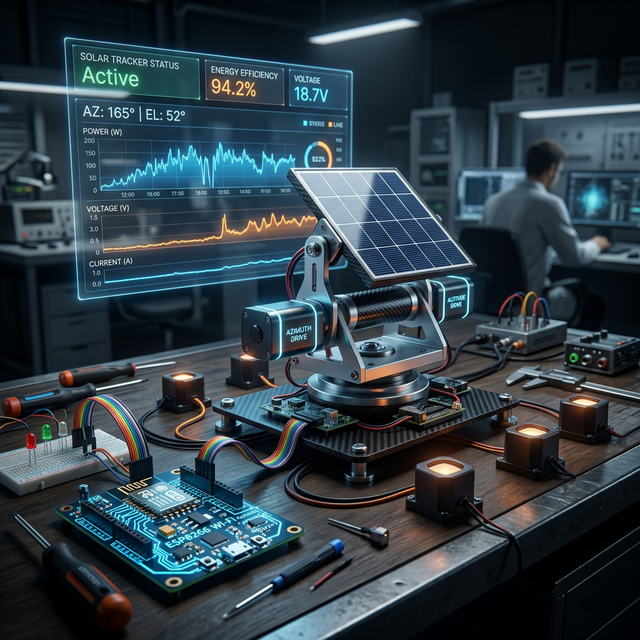
Solar Tracking, Monitoring & Controlling Systemwith ESP8266
Introduction
The search for sustainable energy efficiency has led to significant innovations in how we capture sunlight. While static solar panels are common, they lose a massive percentage of potential energy as the sun moves across the sky. This project presents a Dual-Axis Solar Tracker powered by the ESP8266, which follows the sun in real-time and streams live data to a global dashboard via Firebase. By maintaining a perfect 90-degree incident angle, this system significantly maximizes energy harvest compared to traditional fixed mounts.
Hardware Precision
Dual-Axis Mobility: Using two high-torque servo motors (Horizontal and Vertical), the system can rotate nearly 180 degrees in multiple directions.
Sensor Array: Four LDRs (Top-Left, TR, BL, BR) provide a high-resolution "vision" of where the light is strongest.
Voltage Monitoring: A dedicated sensor on the solar panel monitors energy generation in real-time for efficiency calculations.
Pin Mapping Table
| Component | ESP8266 Bin | NodeMCU Label | Function |
|---|---|---|---|
| LDR Top Left | GPIO 5 | D1 | Light Sensor Input |
| LDR Top Right | GPIO 4 | D2 | Light Sensor Input |
| LDR Bottom Left | GPIO 14 | D5 | Light Sensor Input |
| LDR Bottom Right | GPIO 12 | D6 | Light Sensor Input |
| Horizontal Servo | GPIO 13 | D7 | Movement Control |
| Vertical Servo | GPIO 15 | D8 | Movement Control |
| Voltage Sensor | A0 | A0 | Analog Voltage Read |
Connection Schematic
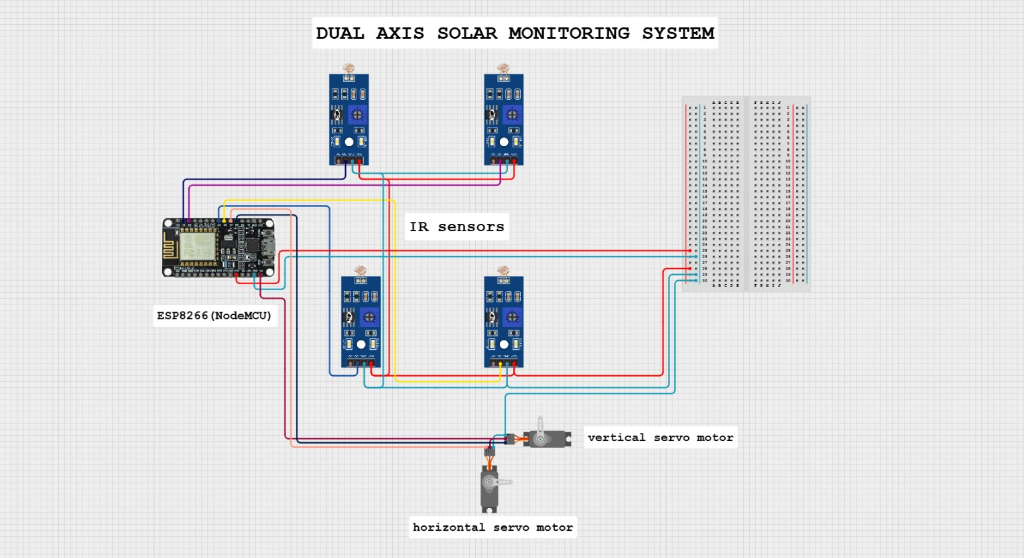
Use a separate 5V power supply for the servo motors. This is critical to prevent system resets and ensure stable operation during heavy movement.
"Smart" Tracking Logic
Unlike simple trackers, this system uses a Differential Centering Algorithm to ensure the panel is always perpendicular to the sun's rays. It calculates the delta between opposing sensors and applies corrective movement.
Differential Logic
Compares light intensity between opposing sensors to calculate the precise error vector.
Auto-Home System
Performs a smooth return to home position (90/45) after 3s of darkness detected.
Deadzone Tuning
Prevents motor 'hunting' and jitter by ignoring small insignificant imbalances.
Smooth Stepping
Moves in 2-degree increments with 15ms buffers to prevent sudden current spikes.
Logic Phase Matrix
Prototype & Documentation
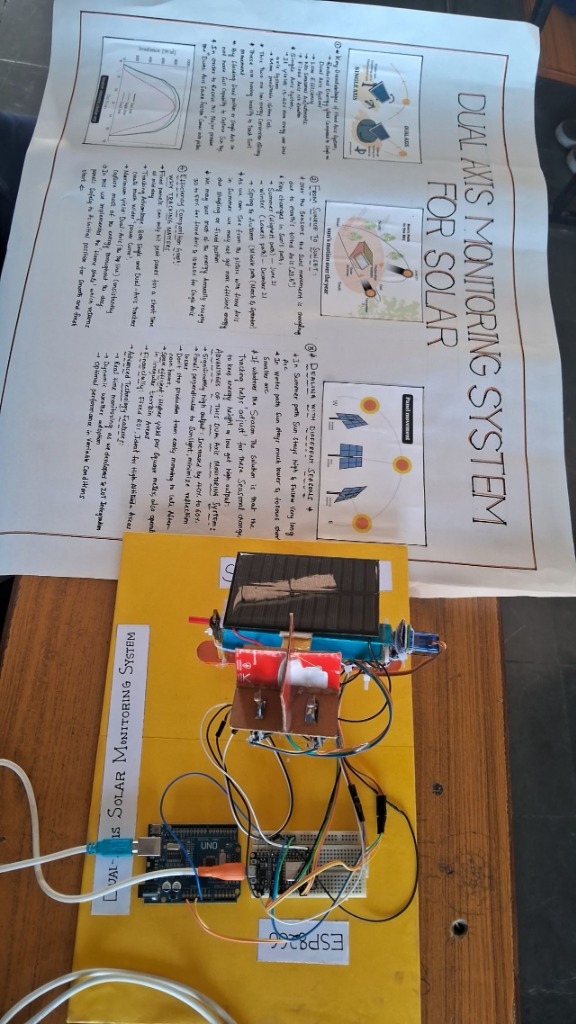
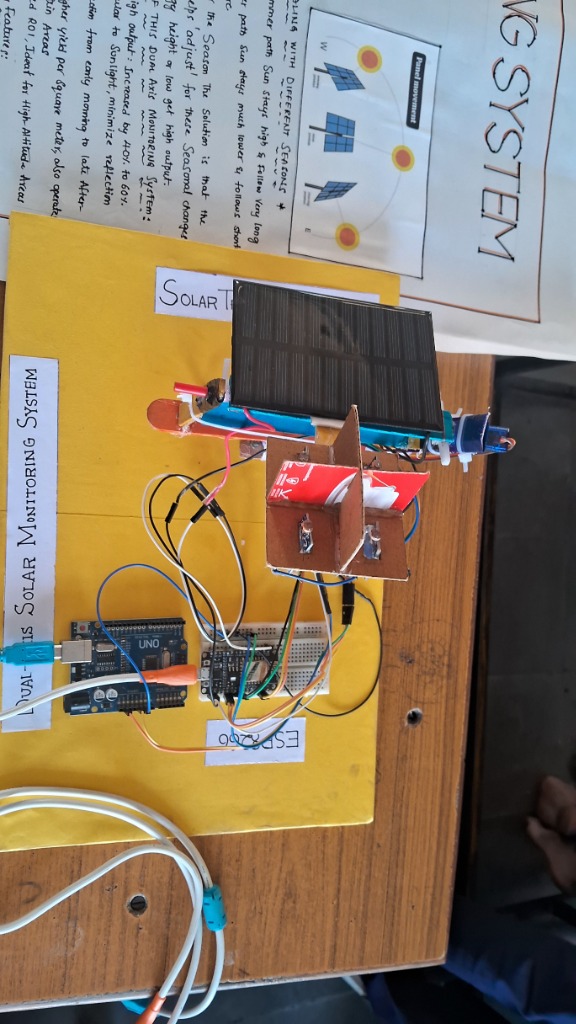
Actual physical hardware implementation accompanied by the comprehensive project presentation. This highlights the structural design and the educational breakdown of the core concepts like seasonal variations and tracking efficiency.
IoT Connectivity
- DatabaseFirebase RTDB
- Sync Latency< 500ms
- Remote ControlActive
Every 500ms, the tracker sends its current angles, voltage, and individual sensor readings to the cloud.
Global Override
Manual mode allows for remote control of elevation and azimuth via dashboard sliders.
Technical Stack
Dashboard Interface
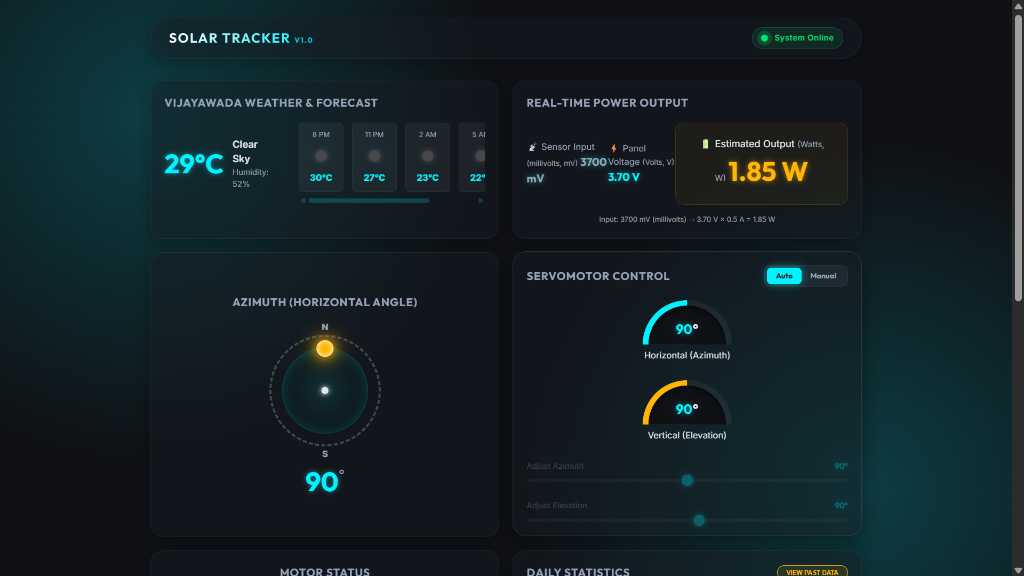
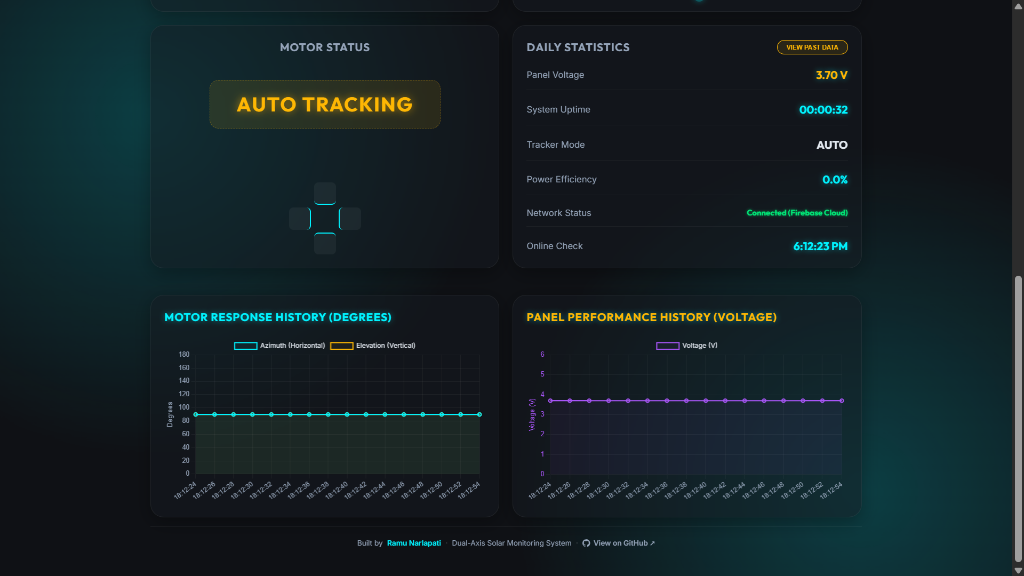
Interactive sliders, power analytics, and heartbeat monitoring system.
Project Stats
Efficiency improvement over static panels in simulated testing.
Conclusion
This Dual-Axis Solar Tracker demonstrates how low-cost microcontrollers and cloud technologies can significantly improve renewable energy infrastructure. By keeping the panel perfectly perpendicular to the sun and providing instant diagnostic data to the user, we bridge the gap between simple hardware and intelligent energy management.
Interested in the technical implementation?
Note: The zip archive is password protected. Password: Rexplorer